27.4.12

Cutting the cake

Bjørn Petter Jelle gave a talk at a school symposium last year with a selection of interesting math problems. I thought his presentation of the cake cutting problem was brilliant.

The classic problem is this: divide a round cake into 8 equal pieces with 3 cuts. He posed the problem and after we discussed in groups, one group offered the classic solution. Quarter the cake with two cuts and then make a third cut horizontally to split the four quarters in half.

Bjørn Petter then produced a cake with lovely sprinkles and big frosting flowers. He offered a knife and asked the group to perform to operation:


The result: a very unsatisfying division of the cake. The bottom pieces have almost no frosting:

Back to the drawing board. Another group proposed stacking the four pieces after the second cut and making the third cut vertically. Bjørn Petter produced a second cake and had them try. It worked better, but the beautiful frosting flowers were crushed. Other ideas?

A third group proposed setting the four pieces in a line and cutting with a really big knife. Bjørn Petter produced a third cake... and a sword!


Afterwards, we all ate cake of course. I got one of the bad pieces. It didn't matter, his presentation and the series of surprises made for one of the best presentations of a classic problem I'd ever seen. Bravo!

26.4.12

Knight Maze

From the Infinity conference a few years back in Ann Arbor, Michigan. I gave a talk on knight mazes and began the talk with a puzzle. You are a chess knight. Start anywhere you like on the left edge of this board and reach the star by moving only legal knight moves on the white squares. You may not leave the board or land on a blue square.

It's a maze I designed especially to be difficult. Give it a try! The talk focused on interesting maze elements and concluded with an analysis of this maze and the key to why it is so challenging.


25.4.12

Fractal Jugglers

"Nothing but Jugglers"

Making a picture containing "nothing but jugglers" presents a special challenge. In order to properly represent jugglers, the people in the scene must be juggling something, but what can those objects be if the only objects allowed are jugglers? We must conclude that the scene is be recursive with the number of jugglers growing exponentially to infinity as their size decreases to nothing.

Here's the scene as an animated gif. Try to follow one red figure, if you can!

23.4.12

4d juggling visualizer

Click on the window to use arrow keys to rotate this model. Shift-arrow keys scale the model. Flash required.

This is a 3-ball cascade juggling pattern. Imagine filming the juggling pattern then stacking the frames of the film to make a 3d model where depth represents time. That's what this shows. Be sure to click in the window to be able to use the arrow keys. Here is a bigger version.

Tetrahedron teabags

I love these teabags! A nice question: if taken apart what is its shape? Next question, if you want to make a large tetrahedron from the same pattern with a piece of A4 paper (or letter-size paper or whatever), what should the dimensions of your template be? Will you account for the overlap? I haven't tried it yet, but I think there will a nice use of √3 in here somewhere.


Silver ratio windows

I was recently at Jyväskylä University in Finland and saw these windows on the Agora building. They looked like silver rectangles to me, so I snapped a picture to measure. Sure enough, nearly exactly by my measurements on the image.


The silver ratio, by the way, is 1+√2 : 1. It has many connections to the golden ratio. It's equal to 2+1/(2+1/(2+1/(2+1/(2+...


 (Replace all of those 2s in the fraction with 1s and you get the golden ratio).

If you add a unit square to a 1:√2 rectangle (A4 paper, for example) you get a silver rectangle. If you subtract a unit square from a 1:√2 rectangle you also get a silver rectangle.

A4 rectangle plus a unit square is silver:
 A4 rectangle minus a unit square is also silver:

And just like you can remove a series of squares infinitely from a golden rectangle, you can remove a series of 2 squares infinitely from a silver rectangle...

There's lots of other cool properties... I've been fascinated with these "precious metal ratios" lately (gold, silver and yes bronze and others!) so it was exciting to spot these silver ratio windows. I hope this was an instance of intentional mathematics!

Game of Thrones 7-pointed star

I love this motif in the windows in King's Landing in HBO's "Game of Thrones." There are 7 "old gods" in this world which I think are the basis for the pattern of this design. Nice seven-pointed star!

22.4.12

Boggle

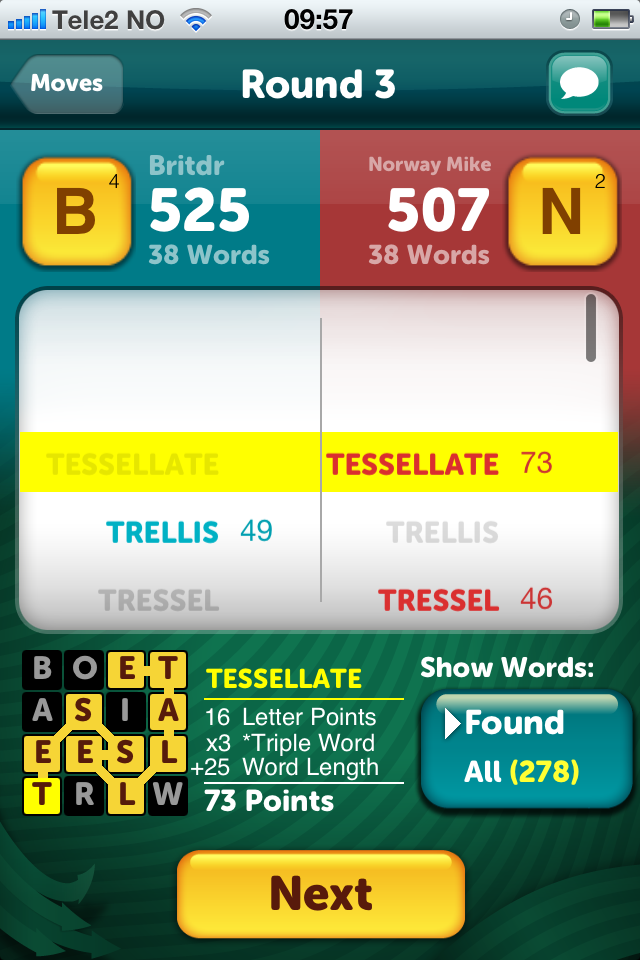
I found this nice 10-letter word playing Scramble (Boggle) on my iPhone. The board was one letter shy of making 'tessellation' (you can see the grid in the lower left).


21.4.12

Human Cube

Here's my Human Cube sculpture, painted. I'm quite pleased with the result. It will be exhibited this summer in the College of Fine Arts Gallery at Towson University, Baltimore MD.

If you'd like a copy of the model, it is available (unpainted) for purchase at Shapeways.com.

20.4.12

Lying with statistics

I've talked about how to lie with statistics in some of my university courses. It was with amusement and horror that I saw this at my kids' school. The school scored 2.3 on 5th grade national math test, compared with 2.0 for other schools in the area. This is 17% higher, not 200% higher as the graphic suggests (the base line starts at 1.85 instead of 0). Really, isn't 17% enough?


3.4.12

Carpet puzzle

Waiting in a meeting room at a hotel in Norway after I'd set up for a talk, I became interested in the carpet. I mean, who wouldn't? Carpets are cool. I wanted to spot the repeating unit; which section could be cut out and used as a "stamp" to make the entire pattern? It was a captivating exercise. Maybe you want to try... can you find the repeating unit in this carpet pattern?

 
Here's one solution, click on it to make it larger. I've marked the four corners of one possible repeating unit with small blue blocks. Note that the corners I found make a parallelogram, does this affect producing the carpet and laying it out? This carpet was all over and in some rather large rooms. How do manage to roll this out so the patterns on adjacent pieces match?

There are puzzles to be found everywhere!

24.3.12

Judge's collar tessellation

In the Storsalen in Trondheim Rådhuset (Trondheim City Hall). This piece of wall art is made from the collars that judges used to wear as part of their costume. The collars are connected by folding them naturally into y-shapes and buttoning them together to make hexagons. Excellent use of discarded costume bits.


10.3.12

3d moving ball surface


Here's a very cool piece of ceiling art at one of the Olympics building in Beijing. This video was taken by my friend Nils Kristian Rossing.

13.2.12

Sizing your skis

I was trying to find some info on sizing my daughter's skis. Here's some interesting sizing advice from an article at ehow.com, January 2012:

See the problem with the formula? Multiply your height by 2.6 and then divide by 25 to find your ski length. Or, just divide your height by 10 essentially. I'm 6'1", or 73 inches, so my skis should be 7 inches long. That's nice, I can fit them in my pocket. No more struggling to get them into the car. Unfortunately, my ski boots are twice that length, so I'm not sure I'm going to attach the bindings.

I found the original article at Ski Post, and they write:

"For Traditional length classical skis (Your height in inches) x 2.6 + 15 inches = approximate ski length in cm."

There's still conversion and unit issues here. Better:

(Your height in inches) x 2.54 cm/in + 15 cm = approximate ski lenghth.

Or how about just: Your height + four to twelve inches?

11.11.11

11^6

Where were you 11/11/11 at 11:11:11? Here's me at the moment, in the minibus.


One of my former students in Washington used to always make a wish at 11:11. I just heard that this time, as she was making her wish, her boyfriend ran into the room with a ring saying his wish was to spend the rest of his life with her. Awesome! Congratulations L.Z.!

25.10.11

Mathematical Aesthetics in a Beautiful Town

One of my works from the 2011 Bridges Mathematical Art Conference in Coimbra Portugal made it into the Notice of the AMS. Here's a link to the article and a screen shot of one of the pages.


12.10.11

xkcd puzzle

Here's a fun calculation from xkcd.com. Puzzle: why does this work? Can you find other numbers in which the same trick applies? Can you generalize?


25.9.11

Prime number chemistry

It's Forskningsdagene, or Research Days, in Norway. Many big cities have special events to celebrate science research. In Trondheim there are series of shows and lectures and the Research "Torg" (market/square/court?) Every year, the math center participates in the torg, and for the past few years I've been in charge of planning and coordinating the event with the university's math department.

The theme for this year was chemistry, so we decided to 'number chemistry'. I've always thought of the integers like molecules, with prime numbers as the atoms. We set up number molecule decorations, a prime number target game, and computers where visitors could find the prime factorizations of their phone numbers.

Students for the math department made the decorations and the ball toss game and did a very nice job. I wrote the program to find the factorizations, and we all made a variety of signs talking about primes, twin primes, the GIMPS project, and some prime number periodic tables that are pretty cool.

The game was a big success. Kids waiting in line were given a card with a number on it, maybe 18 or 54 or 770. The would need to figure out the prime factors by the time they got to the front. They would then throw balls at targets painted with primes, the goal being to knock down primes whose product matched the target number. Winners wrote their names on a sticky note and stuck it on the wall, enough of reward to make players proud without having to hand out candy.

Here's my periodic table of prime numbers, made to match the chemistry theme of the day and drive home the idea of "primes as atoms". Twin primes are colored gray, with symbols added for Mersenne primes, Sophie Germaine primes, Fermat primes, and palindrome primes. I think it came out nice!


I went through many iterations of the table. I harbored an unfounded hope that maybe by organizing the integers in a different form maybe some kind of cool pattern would pop out. Here's the periodic table shape with integers starting at 1 and all of the prime numbers colored blue. It turns out that even in the periodic table format, the primes appear to be patternless. I don't know whether to be happy or sad.


23.9.11

Math mistakes in kids' books 2

This symmetry error comes from "5 minutter historie" (="5 minute stories"). The concept of this book is brilliant, about 50 stories each that can be read in five minutes. In the story "Princessen som aldri smilte" ("The princess who never smiled"), a princess is cursed by her nanny to never smile unless someone can guess her (the nanny's) name. The king and queen hire professional name guesses and try all manners of amusing the princess to get her to smile, but nothing works. One day, a painter makes a funny picture of the nanny and writes AMME (Norwegian for 'nanny') on the painting. The princess catches sight of the word reflected in the mirror and guesses "Emma" as the nanny's name, and the spell is broken.

OK, so apart from the idea that the kingdom guess every imaginable name but somehow forgot to try the common name 'Emma', can you spot the errors both in the text and the illustration?


PS: upon discussing these errors with my 8-year old daughter, she had to try writing words and looking at them in a mirror to discover what word was written on the painting. Afterwards, she became so fascinated with backwards writing that she's been doing it for days, leaving me "secret messages" that can only be read with help of a mirror! Maybe mistakes can be awesome sometimes!

Math mistakes in kids' books 1

I found some math mistake in my daughter's bedtime stories this past month. The first comes from "Ask Mia", a storybook from the Math Matters series. This is an excellent story in which the characters are motivated to create a pictograph to convince a newspaper editor to change her idea of what the paper's content should be. On the final pages is a picture of the newspaper, including this puzzle:

Luis's Quiz: If a hen-and-a-half lays an egg-and-a-half in a day-and-a-half, how many eggs does one hen lay in one day?

The incorrect answer of 'one egg' is given. What is the correct answer?